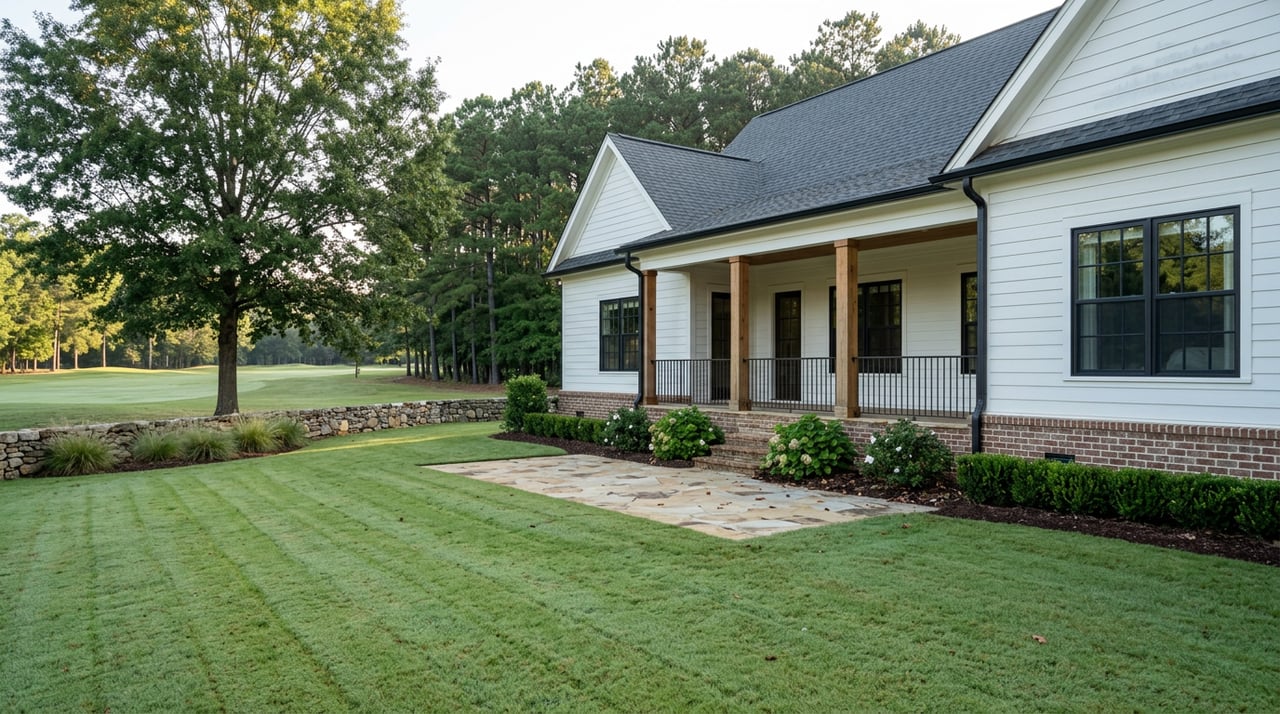
A 1.24-acre lot on the 8th fairway of the Mind Breaker course, part of the Robert Trent Jones Golf Trail in Glencoe, was listed this year at $49,900. The description read the way these listings always read: cleared, gently sloping, gorgeous views of the fairway and green. What it did not mention, because listing copy never does, is that buying frontage on a golf hole means accepting a piece of paper that gives golfers a standing legal right to walk onto that lot and take their ball back.
That paper is not a rumor or a scare tactic. It is standard practice in golf-course communities across the country, and it is almost certainly recorded somewhere in Silver Lakes' covenants for whatever phase or section a given lot sits in. The problem is that almost nobody asks to see it before they fall for the view.
What "Frontage" Actually Means Here
Silver Lakes is not a small subdivision with a shared green space. It is a 450-acre, 36-hole complex that opened in November 1993 as the seventh stop on the Robert Trent Jones Golf Trail, developed by the Retirement Systems of Alabama. It has served as Jacksonville State University's home golf course, and Masters champion Danny Willett played there during his two years at JSU before crediting that course time toward his 2016 tournament win. That pedigree is part of why lots along its fairways carry a premium over a typical Glencoe building lot, and it is also exactly why the golf-ball easement question matters more here than it would on a random cul-de-sac.
In golf-course communities nationally, the standard mechanism looks something like this: the developer or the golf course records language in the covenants that burdens every lot with an easement permitting golf balls to unintentionally land on the property, along with a right for golfers to retrieve them. Real estate attorneys who write about these communities describe the effect plainly, noting that owners typically "assume all risks associated with errant golf balls" the moment they take the deed. Courts have upheld that language even in cases involving dozens of broken windows a year, because the easement was properly recorded and the buyer took title subject to it.
None of that means every Silver Lakes lot carries identical exposure. It means the actual language matters, and the actual language lives in a document a buyer has to go pull, not in the listing photos.
Three Courses, Three Different Bets
Part of what makes this worth spelling out for Silver Lakes specifically is that the community is not one uniform ring of fairways. It is three nine-hole courses plus a short course, and each one plays differently in ways that translate directly into how much of that easement risk a given lot is actually taking on.
The Mindbreaker nine is built through woods, water, and wetlands, with shorter, more elusive holes that reward accuracy over distance. A lot backing up to a Mindbreaker fairway, like the one on the 8th hole listed earlier this year, sits closer to a course designed around tight, technical shots rather than long bombs that could sail wide.
The Heartbreaker nine is the opposite kind of proposition on its closing stretch, where the final three holes are built around dramatic elevation changes and lake views, the kind of terrain that tends to produce more misdirected shots, not fewer.
The Backbreaker nine plays wide open, with broad fairways and foothill views, a layout more forgiving of an errant swing simply because there is more room for the ball to land short of a house.
A buyer comparing two listings that both say "golf course lot" is not comparing two versions of the same risk. They are comparing three different course geometries, and the covenant language attached to a lot should be read with that specific hole in mind, not the marketing phrase "golf frontage" in general.
The Paperwork That Can Actually Stall a Closing
The easement question is about what you are agreeing to live with. The HOA question is about what can keep you from closing at all.
Alabama law treats homeowners association authority as a function of whatever the community's recorded governing documents say, and Silver Lakes lots are consistently marketed with language noting HOA restrictions alongside amenities like street lights, curbs and gutters, sidewalks, and underground utilities. That means membership, dues, and enforcement in Silver Lakes flow from a declaration filed against the land, not from something a buyer can opt out of by skipping a homeowners meeting.
Alabama's rules on the enforcement side are specific enough to matter at the closing table. If dues go unpaid, the association can place a lien on the property, and once that lien is recorded, the property cannot be sold or refinanced until the debt is cleared. Before an association can move to foreclose on that lien, state guidance requires written notice to the homeowner and time to cure the delinquency first, but the lien itself is what freezes a transaction in the meantime.
For a buyer, that means a clean sale on a Silver Lakes lot depends on confirming the seller's dues are current before an offer goes in, not after. For a seller, it means a payment that fell behind two years ago and was forgotten can surface at exactly the wrong moment in escrow.
Before You Write an Offer
A few requests up front save a lot of friction later, especially on a lot this specific:
- Ask for the recorded Declaration of Covenants that applies to that lot's phase or section, not a generic community summary
- Confirm in writing that HOA dues are current and request a payoff or estoppel letter if any lien history exists
- Get a plat or survey that shows the lot's actual distance from the tee, fairway, or green rather than relying on a listing photo
- Ask whether the specific course fronting the lot, Mindbreaker, Heartbreaker, or Backbreaker, has any documented history of ball strikes on that section
None of this requires a lawyer to check on your own. It requires knowing which document to ask for and reading it before the inspection period runs out, not after.
A Few Direct Questions
Do I have to join the golf club to buy a Silver Lakes lot? Club membership and HOA membership are usually two separate things. The HOA obligation comes from the recorded covenants attached to the lot itself, while golf club membership is typically a separate arrangement with the course. Confirm which one is mandatory for a specific lot before assuming either way.
Who pays if a golf ball damages my house? In most golf-course communities, the recorded easement protects the course, the developer, and the club from liability for stray balls, which leaves the homeowner to pursue the individual golfer directly, a path that is rarely practical. This is exactly why checking for the easement language before closing matters more than checking it after a window breaks.
Does the HOA maintain the golf course itself? Not typically. HOA dues in a golf-course community usually cover neighborhood infrastructure and common areas rather than course maintenance, which is generally handled separately by the golf operation. Ask specifically what the dues fund before assuming they cover the fairway view you are paying for.
A fairway view is a real amenity, and Silver Lakes has a legitimate one, part of the Robert Trent Jones Trail, built by people who know golf, backed by more than three decades of tournament and collegiate play. But the paperwork attached to that view is not optional reading. If you are weighing a lot on any of Silver Lakes' three nines, or a resale inside the community, Impact Realty can walk the actual recorded covenants with you before you write an offer, not after you are already past due diligence.